The Ridgeline continues to be powered by Honda's 3.5-liter V-6 engine which produces 250-horsepower and 247 foot-pount of torque . Transmission is a five-speed automatic. Fuel economy is a decent 15 mpg city and 20 highway.
Pricing has not been released yet on the 2011 Honda Ridgeline.
Full details can be found in the press release below.
2011 Honda Ridgeline Offers Unique Pickup Truck Utility
07/02/2010 - TORRANCE, Calif. - The five-passenger Honda Ridgeline half-ton pickup truck is built with a closed-box, unitized body structure for a unique combination of capability, interior spaciousness and comfortable ride performance.
The Ridgeline delivers a wide range of conventional pickup capabilities with a maximum tow rating of 5,000 pounds and a half-ton payload rating, all while offering unique features like a large In-Bed Trunk® and an independent front and rear suspension.
“The Honda Ridgeline focuses on delivering the most-popular features and capabilities that a majority of recreational truck buyers typically use and need,” said Erik Berkman, vice president of American Honda Motor *** Inc. “As a company that also builds world-class motorcycles, ATVs, marine engines and power equipment, many features in the Ridgeline represent the best thinking from Honda.”
The four-door, five-passenger Ridgeline is powered by a 250-horsepower, 3.5-liter VTEC V-6 engine. A 5-speed electronically-controlled automatic transmission and a Variable Torque Management® 4-wheel drive system (VTM-4®) are standard. The EPA rates city/highway/combined fuel economy1 at 15/20/17. A MacPherson strut front suspension in the front and a rear multi-link suspension design contribute to a smooth ride and responsive handling. Standard equipment for towing includes an integrated tow hitch, transmission and oil coolers, heavy duty brakes, dual radiator fans and a wiring harness for a 7-pin trailer hook up (pre-wiring only on RT).
A 5-foot-long composite cargo bed with eight tie-down locations provides a half-ton payload rating of 1,100 pounds. Four cargo area lights illuminate both the bed and the in-bed trunk. A dual-action tailgate opens down for traditional access to the cargo area or to the side for ease-of-access to the 8.5 cubic-foot In-Bed Trunk. The Ridgeline is available with a wide variety of accessories and can conveniently accommodate motorcycles and ATVs.
The all-aluminum, 60-degree, SOHC 3.5-liter VTEC engine produces 250-horsepower at 5,700 rpm and 247 lb-ft. of torque at 4,300 rpm. The Ridgeline’s variable valve timing enhances low rpm torque while extending high rpm horsepower for a broad, confidence-inspiring power band. The 5-speed electronically controlled automatic transmission features Grade Logic Control to help maintain the most appropriate gear when going uphill or downhill to avoid gear “hunting.” The fully automatic VTM-4 system provides confident operation in rain, snow, ice, sand and mud, while also improving on-road and towing performance by distributing torque to all four wheels as needed. The system operates predominately in front-wheel-drive during dry-pavement cruising conditions and continuously proportions torque to the rear wheels during acceleration and low traction situations.
The Vehicle Stability Assist™ (VSA®) system, commonly referred to as electronic stability control, can apply braking force to a wheel with low traction and direct driving force to the wheel with more traction. For the rear differential, a "VTM-4" lock button located on the instrument panel allows the driver to temporarily hold engagement of both rear wheels to aid traction while in gears “1” and “2” at speeds of up to 18 mph.
The Ridgeline integrates an independent suspension with MacPherson struts in the front and a multi-link with trailing arm design in the rear. The VSA system with active yaw control monitors lateral (cornering) stability and can integrate traction control, four-wheel drive, anti-lock braking, throttle control and stability control functions by modulating brake power at each wheel and controlling throttle input.
The heavy duty braking system includes 12.6-inch front and 13.1-inch rear 4-wheel anti-lock disc brakes with Electronic Brake Distribution (EBD) and Brake Assist. Steel wheels on the Ridgeline RT measure 17x7.5-inch; the Ridgeline RTS upgrades to alloy.
All-season P245/65 R17 tires are standard on the Ridgeline RT and RTS. The Ridgeline RTL is equipped with 18x7.5-inch alloy wheels and all-season P245/60 R18 tires.
The unit-body architecture is designed for vastly superior rigidity compared to traditional body-on-frame designs and provides the foundation for the Ridgeline's spacious interior cabin and bed, outstanding safety performance and class-leading ride and handling performance. The Ridgeline’s modern and athletic design incorporates a solid, one-piece appearance with no separation between the bed and the cab. Large truck-style side mirrors enhance rear vision while towing. The windshield wipers have a heated wiper zone to enhance wiper performance in cold, winter driving conditions and minimize ice scraping.
|
|
|---|
Friday, November 26, 2010
Few Changes in 2011 Honda Ridgeline Pickup Truck
Saturday, November 13, 2010
Hero honda cd deluxe-upgraded versions
Hero Honda Achiever new ATFT engine
Tuesday, August 24, 2010
Hero Honda Hunk in -Srilanka Bike buy and sell
Rs: 173,709+ VAT ( Jacket and Helmet FREE )
- Digital Speedo Console with an analogue tachometer
- Rear Disc Brake
- Led Tail Lamp
- New Front Fender Design
- New Visor design
- New exhaust shroud
- Tubeless Tyres
- Maintenance free battery
Monday, August 23, 2010
Hero honda pleasure Scooter 2010
Hero Honda passion pro in srilanka
- Stylish New Graphics
- New Visor with Black Tinted Wind Screen and Clear lens indicator
- New Sporty Console & Handle Bar Holder cover.
- All Black glossy Muffler
- Red Rear Cushion Spring
- Body Colored Rear Grip
- Body Colored Rear View Mirrors
- All Black Front Shock Absorber & leg guard
The Hero Honda Passion Pro Power Start has the same specifications as the Passion Plus. It has a 97.2 cc single cylinder air cooled engine that produces 7.5 PS at 8000 RPM, and is one of the best sellers in the 100 cc category. You get a top speed of 85 kmph and 50-55 kmpl in the city, 60-65 kmpl on the highway. It's new low friction technology engine gives more power, better torque and fuel efficiency. It has a high intensity headlight even at lower speeds and a front disc option.
Variants, Shades & Price
- Kick Start : with spoke wheels, kick start and front-rear drum brakes.
- Leaf Green Metallic
- Sports Red
- Black with Sports Red
- Vibrant Blue
- Force Silver
- Black with Frost Blue
Honda Shine 125cc to Honda CB Shine
With that being said what are new reasons for more shine on the new Honda CB Shine?
New graphics
Handle bar weights
New viscous air filter
Maintenance-free battery
The fuel tank comes with supporting knew recess and neatly chiseled. The cap is retained as in the old, chrome and the new 3D Honda wing emblem on the fuel tank gives that edge coupled with the graphics that add to the elegance.
There is nothing new as to the power plant of the new Honda Shine. It runs on a 125cc ‘Optimax’ engine generating a power of 10.3 BHP. The Optimax Engine comes with tall gearing which is better than the previous version. The Honda claims that the Optimax is capable of generating maximum torque at low rpm, implying better pickup and mileage. As to the new Optimax engine, it is actually a 4-stroke, air-cooled and single-cylinder engine – nothing but scaled down variant of Unicorn engine. The engine takes off the bike from 0-60 km speed in 5.3 seconds.
The new Honda CB Shine comes in 5 shades:
Rebel Red Metallic
Geny Grey Metallic
Vibrant Blue Metallic
Black with red stripes
Black with grey stripes
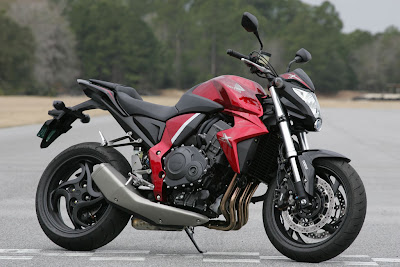
Honda CB1000R-well and truly a wonderful machine
The 2010 Honda CB1000R brings it in line with the other motorcycles in the Honda model lineup, the CB1000R a motorcycle that is deceptive in its ability to go fast in comfort thanks to its supersport engine and light chassis.
Sitting on the new Honda CB1000R the difference is noticeable – the new Honda perches you 30 millimeters higher and when matched to the wide handlebars and low pegs, the CB1000R becomes almost dirtbike-like, with great leverage and stability.

My gripe about the top-soft rear suspension proved to be consistent with other riders who tested the CB1000R and the soft seat padding sinks to its base and makes for a rather uncomfortable ride – but these were the only major issues with the Honda CB1000R.
You can feel the superbike heritage in the Honda CB1000R – the engine produces waves of delicious torque that stays consistent once above 4000 rpm and the gearbox – once warm oil is flowing around the cases – provides beautifully smooth and solid gear changes – I say warm oil because the gearbox was rather clunky when cold.
The final ratio is tall. The Honda CB1000R would probably benefit from a single-tooth drop in the rear sprocket for a bit more snappy acceleration but power is still plentiful at almost any rev speed.
The Honda CB1000R's wheelbase is 15 millimeter shorter than the Yamaha FZ1, although it doesn't feel like it. The riding position is less cramped which gives the rider more room to move and those wider handlebars are great for slicing through twisty roads.
The Honda CB1000R looks tough and purposeful, with sleek bodywork that combines nicely with no odd bits sticking out where they shouldn't. And I love the single-sided swingarm. The CB1000R is no racebike – but it's hot.
The dash is good although the tacho is located too low to b e easily visible, but big clocks would have spoiled t. The Honda CB1000R could be a sign of things to come from Japan.
Honda CB Dazzler 2010
Friday, July 2, 2010
Honda coming with Electric Motorcycle 2010
Honda CB Unicorn Dazzler
The bike boasts of a very very aggressive styling with bikini fairing with screenless front cowls, Honda emblem embossed huge side cowls similar to the Twister, twin tone seats, sporty half chain cover, and a really cool tail.
The bike sports the 150cc engine and HMSI has increased the power output by 0.7bhp with output going up to 14 bhp. The bike is more powerful that the Achiever or the CB Unicorn, but still lacks behind from the Hunk and CBZ extreme. The peak power produced is 8500rpm that is 500 more than the old 8000 rpm from Unicorn.
The bike is more lighter than the old Unicorn, and nearly 8kg lighter. It seems the company has understood the importance of keeping the bike weight low.
The bike no longer support kick start. The bike has completely eradicated the kick start option to go along with the crowd. But, the bike could easily have retained it along with the button start option.
The bike sports a very cool digital console that sports the tachometer, information lights, blue backlit digital speedometer, tripmeter, clock, and fuel meter. Also, the bike has a reduced fuel tank with 1 liter less capacity then the 13 liter old Unicorn. The bike will boasts good fuel efficiency with 60kmpl on Indian roads. The other features include Vibrations dampeners, Maintenance Free 12Volt 4Ah Maintenance Free Battery (The older Unicorn comes with 12V 7Ah), Viscous Air Filter etc.
Wednesday, June 23, 2010
Honda CR-Z-
I should admit to having two vested interests here: firstly as a former CR-X owner back in the 1980's and secondly as a Honda designer for a decade in the 1990's. We were forever proposing CR-X updates then and I must have worked on at least three replacement projects, so I'm not totally impartial on this one.
The CR-X reborn
When the first generation CR-X was launched in 1983, it was a unique proposition: a hi-tech baby coupe with twin roles as an entry car for college kids in the US and a sportier hot hatch for other markets. The second-generation CR-X offered much more powerful and advanced VTEC engines and full 2+2 seating, while the third-generation ‘Del Sol' model took a different turn with its odd two-seat targa styling and complicated stow-in-the-trunk roof.
In many ways the CR-Z is a straightforward update of the original concept: a very advanced low-slung coupe with modest power, in this case supplemented by an electric motor.
Viewing the car in bright sunlight, there's much more volume in the fenders than photos suggest. Together with the flowing roof, short hood, heavy tinted glass and big, curved screen, they give the car an impressive stance. Less impressive is the cheap-looking front grille that doesn't have the attention to detail you'd find on a VW or Citroën these days. It's not so much the hexagon texture of the grille that let it down, but the three unrefined bars in the top section with blanked-off areas behind and the crude mounting of the license plate.
Available in S, Sport and GT trim levels, the top-spec GT adds a glass moonroof, leather front seats, blue-look lenses on the HID lamps and LED running lamps over the Sport we drove.
From the inside
Getting into the car feels very familiar to a former CR-X owner. The wide doors, low set driving position, the over-the-shoulder view and the tiny sunroof brings the memories flooding back.
The cockpit's design is very ergonomic and the golf ball-sized shifter has a high tactile quality to it. There are numerous bins in which to store loose items and generally, there's decent visibility out of the driver's seat. The only real hindrance is the bar that travels across the backlight, which significantly impedes rearward visibility.
There's also a busy use of materials in this interior, which is typical of current Hondas. Smoked chrome is used on outer edges of the console, across the top under the center display screen and on door grabhandles. There's an open weave texture used in the lower spoke of the steering wheel and sides of the console, with matte aluminum used on the steering wheel spokes, around the gearshift gaiter and gearknob.
The inner door releases have the same finish yet appear low rent, and lacking the attention that VW designers would lavish here these days. And, while the main impression is of good quality, some switchgear also seems a bit dated – the electric window buttons and the door lock paddles for instance.
Tuesday, June 22, 2010
Honda EVO6 Concept: 2-Wheels
Car concepts are a dime a dozen these days. If there's a motor show on, you can guarantee there'll be a concept car. But the concept bike is an entirely different commodity. It's a far more rare beast, and sometimes far more interesting.
Headed for the Tokyo Motor Show in October 2007, the EVO6 Concept is Honda's latest attempt to test the naked performance bike waters again. When we say performance, we mean it.
This EVO6 Concept is powered by a 1.8-litre 6-cylinder engine. And it's no ordinary V6 or straight six either, it's a horizontally opposed, or boxer six. Using the same principles as the engine that sits in Subaru's WRX STI and Porsche's 911 Carrera, the EVO6 Concept would make a mockery of the quarter mile drag, while dispatching the zero to 100km/h dash quicker than a Bugatti Veyron.
The huge 6-cylinder engine comes from the Honda Gold Wing, one of the Honda's largest bikes. It's also one of the heaviest bikes on the road too, while the EVO6 is a naked bike, stripped of all its fairing and other parts to leave it not only lighter, but far sexier too.
The huge 1800cc engine is clearly visible as a stressed member of the bike, surrounded by a barely any frame. Huge front brake discs and sports tyres indicate that this concept bike has been developed to be a serious-ish ride, and the front end with its stylised headlight, ram air intakes, and upside-down forks look good.
There's also a single-sided swingarm, 8-spoke chrome wheel rims, and the tail end is impressively minimal. With a good amount of chrome and not too much plastic-fantastic, the EVO6 would make for a very pretty naked bike.
As it's only a concept at this stage there's no plans on building a production model but it does show intent. Honda's rivals have recently taken the lead in the naked bike class, one of the most popular in the world, and it's now clear that Honda wants to drop a bomb on the genre.
Suzuki is planning on shoving its legendary 1340cc Hayabusa engine in a new unfaired motorbike, and there's even been talk of Kawasaki using the engine from the ZX-14 for a naked bike.
We would expect the EVO6 Concept to deliver about 240hp or about 179kW. But more importantly it will deliver huge amounts of torque.
Stay tuned to the Motoring Channel for all the new motorbike and car releases fresh from the Tokyo Auto Show.
world's best known and respected automotive brands
You've seen them in magazine ads, on television commercials and on the road. Honda is one of the world's best known and respected automotive brands. The company behind the cars is Honda Motor Company, Ltd., a multinational corporation based in Minami-Aoyama Nichome, Minato, Tokyo, Japan. Honda designs, develops, manufactures and sells popular vehicles such as the Accord, the Civic, the CRV and many others. Honda cars are driven in many different parts of the world.
Not Everything is Done in Japan
Many people incorrectly assume that Japanese cars are manufactured in Japan. The truth is, the world is a much different place today than it was in the late '40's when Honda first started. Globalization has made it possible for multinational corporations to distribute their production facilities around the world for maximum efficiency. For example, even though the companies' world headquarters are in Japan, American Honda Motor Co. is based in Torrance, California. Honda has also created joint ventures around the world to facilitate operations in places such as China and India.
In terms of where the cars are actually made, the answer is - it depends. Honda has several assembly plants distributed around the world, each producing anywhere from only one to five different styles of automobiles. Depending on where in the world you live, and what type of vehicle you are wondering about, the actual geographical origin will vary. Below is a list of their manufacturing and assembly plants with details about what type of vehicles are made there. It is safe to assume that if you live closer to China than the U.S., the assembly plant closest to (or in) China that manufactures any given model is the one where that car came from.
Honda Manufacturing and Production Facilities
Japan
As of 2009, there were only two main manufacturing plants located in Japan.
The Honda Hamamatsu Factory in Hamamatsu, Japan manufactures cars, motorcycles and engines from the car manufacturers complete lineup.
There is another Japanese production facility located in Suzuka, Mie, Japan. Currently, this facility only produces one model - the Honda Fit.
China
The Dongfeng Honda Automobile Company, based in Wuhan, China opened in 2003. This assembly plant currently manufactures only the Honda CRV, but has plans to produce Honda Civics in the near future.
Indonesia
Honda Indonesia is the name of the factory located in Karawang, Indonesia. Currently, this manufacturing facility only produces the Honda Fit.
Thailand
In Thailand, Honda manufactures the Honda Fit in their factory located in Ayutthaya, Thailand.
Turkey
Honda has a factory in Turkey where it has manufactured cars of different styles since 1992.
New Zealand
Honda New Zealand manufactured cars from 1965 through 1998. The models that were produced in this facility include the Honda City, the Civic and the Accord.
Belgium
The production facility in Belgium makes only motorcycles.
England
In the UK, Honda has manufactured the Civic and the CRV in Swindon, England since 1992.
Brazil
Honda Amazonas Motorcycle is a Brazilian production facility that only manufactures motorcycles. The plant is located in Manaus, Amazonas, Brazil and has made motorcycles since 1976.
Honda Brazil Automobile, a facility located in Indaiatuba, Sao Paolo, Brazil manufactures the Civic and the Fit.
United States
The Marysville Auto Plant in Marysville, Ohio makes Accords, Acuras and motorcycles.
The East Liberty Auto Plant, in East Liberty Ohio, manufactures the Civic, the CRV and the Honda Element.
Honda Manufacturing of Alabama is located in Lincoln, Alabama. The plant, which opened in 2001, manufactures vehicles such as the Honda Odyssey, the Honda Pilot and the Honda J Engine.